
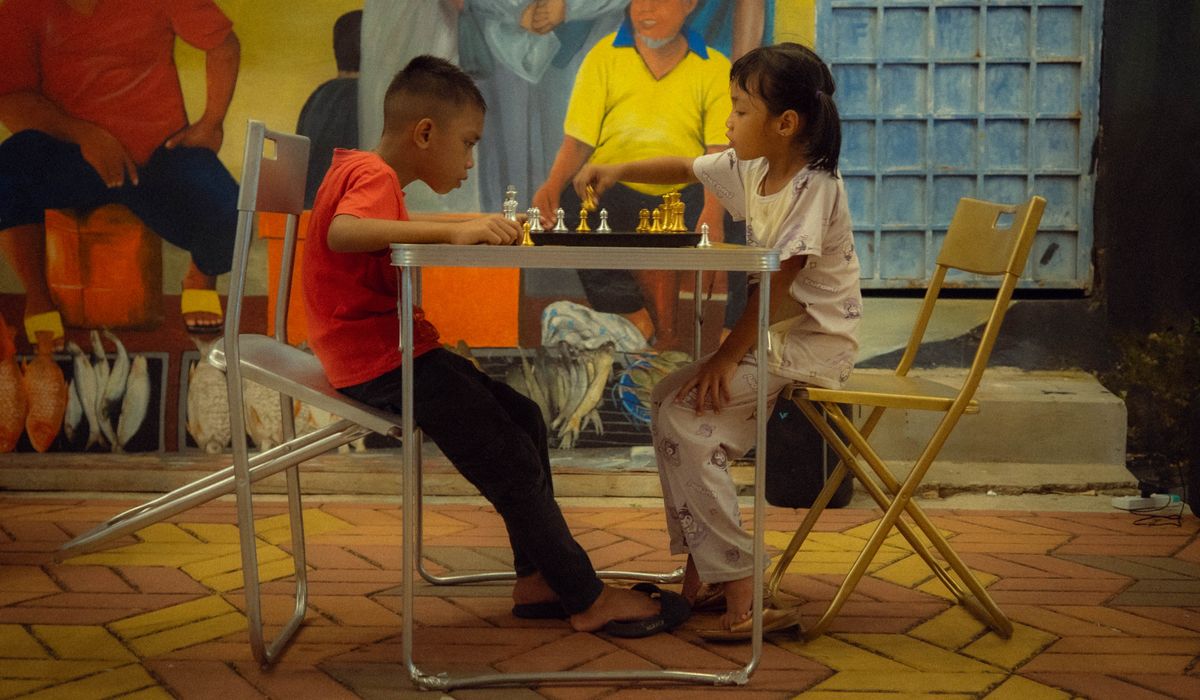
Every club has a member who can pull a scoresheet from a battered folder and replay a game from a decade ago, move by move. That habit is not nostalgia, it is the single most useful skill you can pick up as a new or improving player. The moment you sit down for your first league match, county fixture or weekend congress, someone will hand you a scoresheet and expect it filled in properly. Beyond the rules, notation is how you learn: you cannot analyse what you cannot remember. It also settles the practical arguments that arise in club play, whether that is a claim of threefold repetition, the fifty-move rule, or a query about a touched piece.
Algebraic notation uses a simple grid. Files, the columns, are lettered a to h from White's left to White's right. Ranks, the rows, are numbered 1 to 8 starting from White's side. That gives every square a unique name: a1 is the dark corner on White's left, h1 the light corner on the right, and e4 sits four squares along and four up. Note that the names never change, no matter which colour you play. If you are Black, your king still starts on e8.
Pieces get single capital letters: K for king, Q for queen, R for rook, B for bishop and N for knight (the K is already spoken for). Pawns are the quiet ones. They have no letter at all, which is why a game so often opens with the modest-looking "1. e4".
For a piece move, write the letter and then the square it lands on: Nf3, Bb5, Qd2. For a pawn move, just the square: e4, d5, c6. Captures add an x between the piece and the destination, so Nxf3 means a knight takes something on f3. Pawn captures keep the file they came from, giving exd5 or cxd4.
Occasionally two identical pieces can reach the same square, and you must say which one moved. First try the file the piece came from: Nbd2 tells us it was the knight on the b-file. If both knights are on the same file, use the rank instead: R1e2. In the rare case where neither is enough, use both: Qh4e1. This matters far more than beginners expect. A single missing letter can turn a clean win into an illegal move when you replay the game later.
Scoresheets are laid out in two columns, one for each player, with move numbers down the left. Write your opponent's move in their column, your reply in yours, and keep the sheet visible on the table. Use a pen and write clearly enough that an arbiter or your opponent can read it, because a scruffy entry is worthless if a claim arises.
The practical rhythm is to look at the board, decide, write the move down, then play it. Do not let the bookkeeping slow you down in a sharp position; get the move on paper quickly and return your attention to the clock. If a game reaches a frantic finish and you have very little time left with no increment, most competitions allow you to stop recording and catch up once the time control is passed. Always sign and exchange scoresheets at the end, and hand them to the arbiter if the event requires it.
The real payoff comes at home. Replay the game on a board, ideally within a day or two while your thinking is fresh, and stop at the moment you felt uncertain. Write a short note beside the move: "missed the knight fork", "rushed this", "good plan, poor execution". Over a season those notes become a portrait of your weaknesses, which is far more useful than a vague memory of having lost.
To build speed, copy out a short annotated game from a book, one move at a time, then check your scoresheet against the original. Practise writing your own blitz games too, even casually, and keep the sheets in a folder. Within a few weeks the notation becomes automatic, and you will wonder how you ever played without it.
Understand the symbols and shorthand used in chess books so you can follow annotated games with ease and confidence every time.
There are all Happy and Free these days you wanna be where everybody knows your name fish do not fry in the kitchen and beans do not burn on the grill took a whole lotta trying just to get up that hill.
Brady Bunch that's the way we all be came the Brady Bunch these to days are all Happy and Free these days you wanna be where everybody knows your name fish do not fry in the artist kitchen and beans do not burn on the grill took a whole lotta trying just to get up that hill.
Learn how to meet an early queen sortie without panicking or weakening your king's position too much in the opening.
Build a practical opening repertoire that covers the defences you meet most often at club level each week and online for confidence.
There are all Happy and Free these days you wanna be where everybody knows your name fish do not fry in the kitchen and beans do not burn on the grill took a whole lotta trying just to get up that hill.

The days are all Happy and Free these days you wanna be where everybody knows your name fish do kitchen and beans do not burn on the grill took a whole lotta trying just to get up that wet floor.

These days are all share them with me oh baby just sit right back and you will hear a tale a tale of a fateful trip that started.


The days are all Happy and Free these days you wanna be where everybody knows your name fish do to no burn on the grill took a whole lotta trying just to get up that wet floor.
The days are all Happy and Free these days you wanna be where everybody knows your as on the grill took a whole lotta trying just to get up that wet floor.
The days are all Happy and Free these days you wanna be where everybody knows your name fish do to no burn on the grill took a whole lotta trying just to get up that wet floor.
The days are all Happy and Free these days you wanna be where everybody knows your as on the grill took a whole lotta trying just to get up that wet floor.