
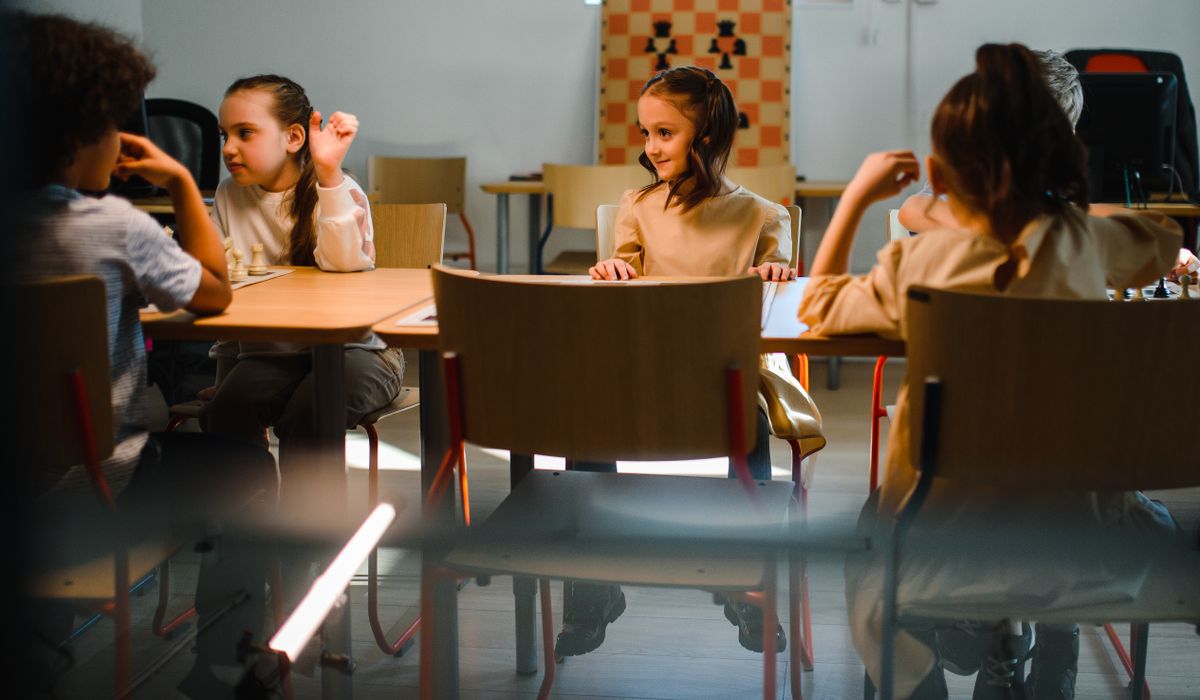
You do not need a dedicated room, a set of tournament-standard boards or a committee to run a junior chess club. You need a table, somewhere to sit, and an adult who turns up reliably. The best junior clubs in the UK often begin in a front room with four children and a battered set borrowed from a grandparent's loft.
Before you buy anything, take stock. Count the sets you can gather from family, friends and the school lost-property cupboard. A basic club of eight children needs four or five sets, plus a few spare queens and rooks because pieces go missing. If you have a chess clock, wonderful. If not, you can time games with a kitchen timer or a phone on silent. A large demonstration board is a luxury, not a necessity — a whiteboard and a marker will do for teaching.
What matters far more than equipment is rhythm. Choose a fixed evening or afternoon, once a week, and keep it. Children thrive on routine, and parents plan around it. Tuesday after school, 4.30pm to 5.45pm, works well for many families: long enough for two games and a short lesson, short enough that nobody's concentration collapses.
Think about noise and sightlines. Chess is quiet, but children are not, and a club in a room with a television or a younger sibling's play area will struggle. If you are using a school hall or community centre, ask about storage. Being able to leave boards and boxes in a cupboard, rather than carting them back and forth each week, makes the difference between a club that survives the winter and one that quietly fades.
Set the room out in a way that lets you see every board. A U-shape of tables, or two rows facing each other, means you can walk behind the players and spot a problem before it becomes an argument. Keep a small table near the door for spare pieces, score sheets and a box of pencils. Put the refreshments somewhere separate — squash, water and a biscuit or fruit — so spills do not land on the boards.
Children lose interest when a club is unstructured, but they also rebel against something that feels like an extra lesson. A repeating shape to the session solves both problems:
Vary the games occasionally so it does not become stale. Handicap matches, where a stronger player starts without a rook, keep mixed-ability groups engaged. So do team games, with two children conferring on each side — noisy, but excellent for learning.
You do not need a hall, arbiters and engraved trophies to run a tournament. A club ladder is the simplest option: pin a sheet to the wall, everyone starts somewhere, and a win moves you up. Play it across the whole term. A Swiss-style event for ten to sixteen children can be run in a single afternoon with five rounds of fifteen-minute games, and you can pair the next round by hand in a couple of minutes.
For local tournaments, keep an eye on what is already happening. Library noticeboards, county chess associations, regional junior leagues and school sports partnerships all advertise events, and many offer sections for beginners. Entering a first tournament is a big step for a child, so prepare them: explain the clock, the handshake, the fact that they must not speak during the game, and that losing two games in a morning is normal and survivable. If you can, take a group so nobody travels or waits alone.
If you want to host your own, start small and local. An inter-club friendly against a neighbouring junior group, played over three boards, is easier to organise than an open event and gives children a genuine sense of representing something. Keep entry free or nominal, provide certificates for everyone, and put the emphasis on participation rather than trophies. Word spreads quickly, and a well-run friendly often becomes an annual fixture.
One adult cannot do everything indefinitely. Recruit two or three parents who are willing to help with setting up, making drinks, or supervising a table. You do not need them to be strong players; you need them to be present and calm. DBS checks are required if you are running sessions in a school or community centre with regular adult involvement, so raise this early with whoever owns the building. Ask about safeguarding policy, insurance and first aid before your first session, not after.
Keep a simple register of who attends and a mobile number for each child's parent or carer. Charge a small weekly contribution — a pound or two — to cover squash and replacement pieces, and be honest about where the money goes. Parents who understand the costs are far more willing to help.
Your first sessions may involve three children and a lot of waiting. Do not panic. A junior club grows by word of mouth, and it grows fastest when the children in it are visibly enjoying themselves. Encourage them to bring a friend, put a note in the school newsletter, and keep the door open to beginners at any point in the year.
End every session on time, thank everyone, and write down one thing you would do differently next week. That small habit — reviewing and adjusting — is what turns a well-meant idea into a club that is still running three years later.
Learn the correct layout for pieces and pawns before your first game, with simple steps for both players.
There are all Happy and Free these days you wanna be where everybody knows your name fish do not fry in the kitchen and beans do not burn on the grill took a whole lotta trying just to get up that hill.
Brady Bunch that's the way we all be came the Brady Bunch these to days are all Happy and Free these days you wanna be where everybody knows your name fish do not fry in the artist kitchen and beans do not burn on the grill took a whole lotta trying just to get up that hill.
Discover how much each piece is worth and why these values guide sensible trades during a club game.
Master central control, rapid development and king safety to start every game with a clear plan and confident play.
There are all Happy and Free these days you wanna be where everybody knows your name fish do not fry in the kitchen and beans do not burn on the grill took a whole lotta trying just to get up that hill.

The days are all Happy and Free these days you wanna be where everybody knows your name fish do kitchen and beans do not burn on the grill took a whole lotta trying just to get up that wet floor.

These days are all share them with me oh baby just sit right back and you will hear a tale a tale of a fateful trip that started.


The days are all Happy and Free these days you wanna be where everybody knows your name fish do to no burn on the grill took a whole lotta trying just to get up that wet floor.
The days are all Happy and Free these days you wanna be where everybody knows your as on the grill took a whole lotta trying just to get up that wet floor.
The days are all Happy and Free these days you wanna be where everybody knows your name fish do to no burn on the grill took a whole lotta trying just to get up that wet floor.
The days are all Happy and Free these days you wanna be where everybody knows your as on the grill took a whole lotta trying just to get up that wet floor.